
Which of the Following Statements About Savings Accounts Is False?
If you’ve seen a quiz, exam, or finance article asking, Which statement about savings accounts is false? you’re not alone. This is one of the most searched personal finance questions online and for good reason. Savings accounts seem simple on the surface, but a lot of misinformation floats around about how they actually work.
Whether you’re studying for a financial literacy test, getting ready for a banking certification exam, or simply aiming to handle your own money with greater confidence, understanding the real guidelines behind savings accounts really matters. Many writers craft quiz questions and multiple-choice answers to sound nearly correct. They frequently blend a genuine fact with a subtle, misleading detail. That’s precisely why true or false savings account questions can be so challenging.
In this guide, we will review common statements about savings account.
We will explain which statements are true.
We will also identify the statement that is usually false. We’ll also cover why the false statement trips so many people up, and what it means for how you actually manage your own savings.
Common Statements About Savings Accounts
Let’s break down the typical options you’ll see in this kind of question:
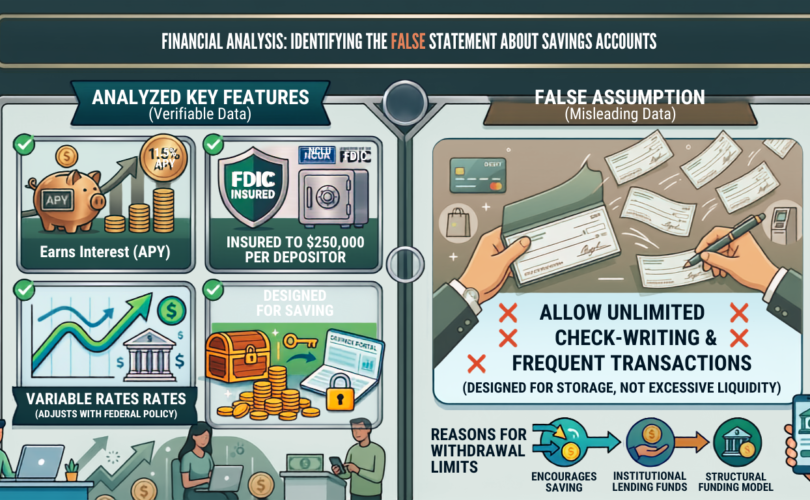
Savings accounts earn interest on the money deposited. True.
This is the core purpose of a savings account. Banks and credit unions pay you interest, often shown as an Annual Percentage Yield (APY). This is for keeping your money with them.
The FDIC (or the NCUA for credit unions) insures savings accounts up to $250,000 per depositor. True. As long as the institution has FDIC insurance, the FDIC protects your deposits up to the standard limit.
Credit unions are covered by NCUA insurance.
You can write unlimited checks directly from a savings account like a checking account. False.
This is the statement that trips people up. Banks design savings accounts for storing money, not for frequent transactions. Most banks limit some withdrawals or transfers from savings accounts. Savings accounts also usually do not allow check writing like checking accounts.
Savings account interest rates can change over time. True. Most savings accounts have variable interest rates.
These rates can rise or fall with Federal Reserve interest rate changes. When the Fed raises or lowers its benchmark rate, banks often change savings account APYs within weeks.
The exact timing and amount can vary by bank.
Savings accounts typically offer lower interest rates than certificates of deposit (CDs). Generally true. Because CDs lock your money for a set term, banks often offer a higher rate.
A standard savings account lets you access your funds more easily.
There is no limit to how much money you can deposit into a savings account. True. Unlike some retirement accounts that cap annual contributions, a standard savings account doesn’t restrict how much you can deposit. The $250,000 insurance limit affects how much is protected, not how much you’re allowed to save.
So, Which Statement Is False?
The false statement is almost always the one claiming savings accounts work like checking accounts. It says they allow unlimited transactions or check-writing. Banks design savings accounts for saving and earning interest not for everyday spending. If you need to write checks or make frequent purchases, a checking account is the right tool for that job.
This distinction exists for a structural reason, not just a banking preference. Banks design checking accounts for liquidity.
You can access your money quickly and often for bills, purchases, and transfers.
Savings accounts are designed for saving money. They encourage you to leave funds in place to earn interest. Banks build their products, fee structures, and account features around that core difference, which is why the unlimited check-writing claim doesn’t hold up.
It is also worth noting that federal rules once limited savings withdrawals to six per month.
They relaxed these rules a few years ago.
Many banks still set their own limits.
Some banks charge extra fees if you use a savings account like a checking account. So even when federal rules change, most savers see little change. Savings accounts still are not for checks or frequent transactions.
Why This Matters
Understanding the real differences between savings and checking accounts helps you:
1.Avoid unexpected account restrictions or fees
2.Choose the right account for your financial goals
3.Make smarter decisions when comparing bank offers
4.Answer personal finance quizzes or certification exams correctly
Beyond passing a quiz, this knowledge has real practical value. Someone who thinks a savings account works like a checking account may trigger a fee.
They might get flagged for excessive transactions. Or they may miss interest by keeping idle cash in the wrong account. Knowing exactly what a savings account is and isn’t for helps you build a smarter, more intentional savings strategy.
How to Choose the Right Savings Account
Since we’ve covered what a savings account shouldn’t do, let’s briefly review what makes a savings account good.
APY (Annual Percentage Yield):
Look for competitive rates, especially from online banks. They often beat traditional banks because they have lower overhead costs.
Minimum balance requirements:
Some accounts charge fees or reduce your rate if your balance dips below a certain threshold.
Accessibility:
Check how easily you can move money in and out. See if the bank offers a mobile app, ATM access, or a linked checking account.
FDIC or NCUA insurance:
Always confirm that the institution has federal insurance before you deposit your money.
Fees: Watch for monthly maintenance fees, high transaction fees, or inactivity fees. These can quietly reduce your interest earnings.
Key Takeaways
1.Savings accounts earn interest that part is true.
2.The FDIC insures deposits up to $250,000 per depositor, per institutionalso true.
3.Savings accounts do not support unlimited check-writing or frequent transactions this statement is false.
4.Interest rates on savings accounts are variable and can change over time true.
Savings accounts carry minimal risk because insurance covers them up to the legal limit. But they are not truly risk-free inflation can reduce your purchasing power over time.
Yes, but many banks apply limits or fees on frequent withdrawals or transfers, unlike a checking account.